

下载APP
PC开播
联系客服
1/1
光&影
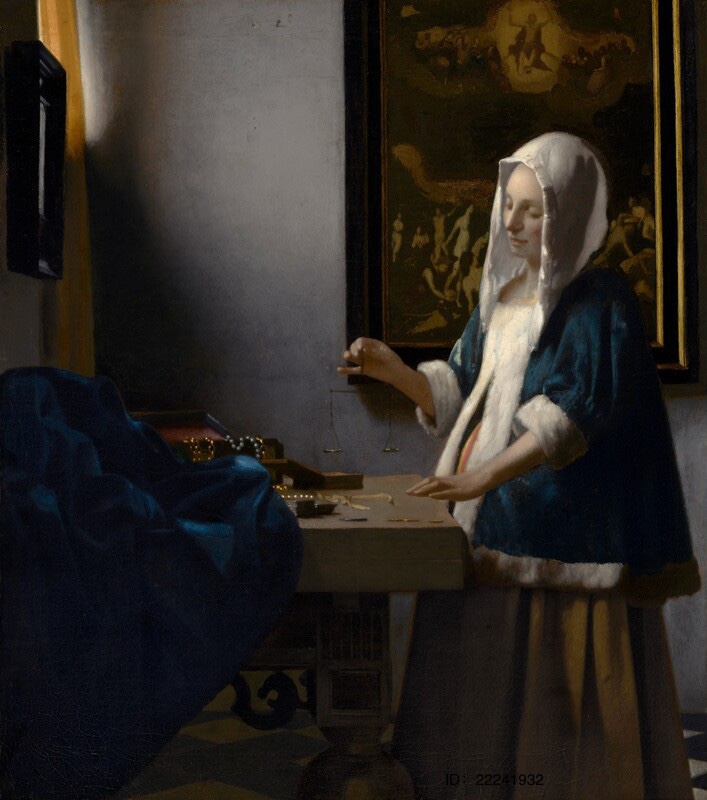
《持天平的女子》
维米尔最杰出的画中画运用手法无疑是《持天平的女子》。我认为,我们可以推断维米尔最初的模特是人格化的虚空女神(Vanitas )。虚空女神的形象被世俗财富的象征物(包括珍珠和镜子)环绕,并与天堂的末日审判场景相结合。在末日审判中,一位复活的灵魂跪在天使长米迦勒面前,他的天平上,世俗的财富(王冠、权杖)与象征精神价值的物品(圣经、念珠)被称量。维米尔将这位女子置于《持天平的女子》的前景,在末日审判之前,使她恰好占据了原本天使长米迦勒——灵魂的称量者——应该站立的位置。维米尔再次通过称量这一比喻,阐明了短暂与永恒、世俗财富与精神价值之间的关联,即从小到大的关系。他借用艾蒂安·约瑟夫·泰奥菲尔·托雷的话告诉我们:“如今你们称量宝石,终有一天你们也将面临被称量和审判!”
Woman Holding a Balance
Vermeer's most accomplished use of the picture-within-a-picture is indisputably to be found in Woman Holding a Balance. Here, I believe, we may assume Vermeer's original model to have been a representation of the personified Vanitas. Surrounded by attributes of earthly riches (including pearls and a mirror), this figure of Vanitas is combined with the representation of a Last Judgment in Heaven. Here, one of the resurrected kneels before the Archangel Michael, on whose scales earthly riches (a crown, a scepter) are weighed against objects symbolizing spiritual values (a Bible, a rosary). Vermeer placed the female figure in the foreground of Woman Holding a Balance, before The Last Judgment, so that she occupies precisely the place where the Archangel Michael, as the Weigher of Souls, would otherwise stand. Vermeer thus again establishes a comparison that, by means of the simile of the act of weighing, makes clear the relation, ex minore ad maius, between transience and eternity, between worldly riches and spiritual values. He tells us, in Etienne Joseph Théophile Thoré's words: "Now you weigh precious stones and gems, one day you in turn will be weighed and judged!"
03-22
 18
 0
 0
 0
评论

发送
 还没有评论哦